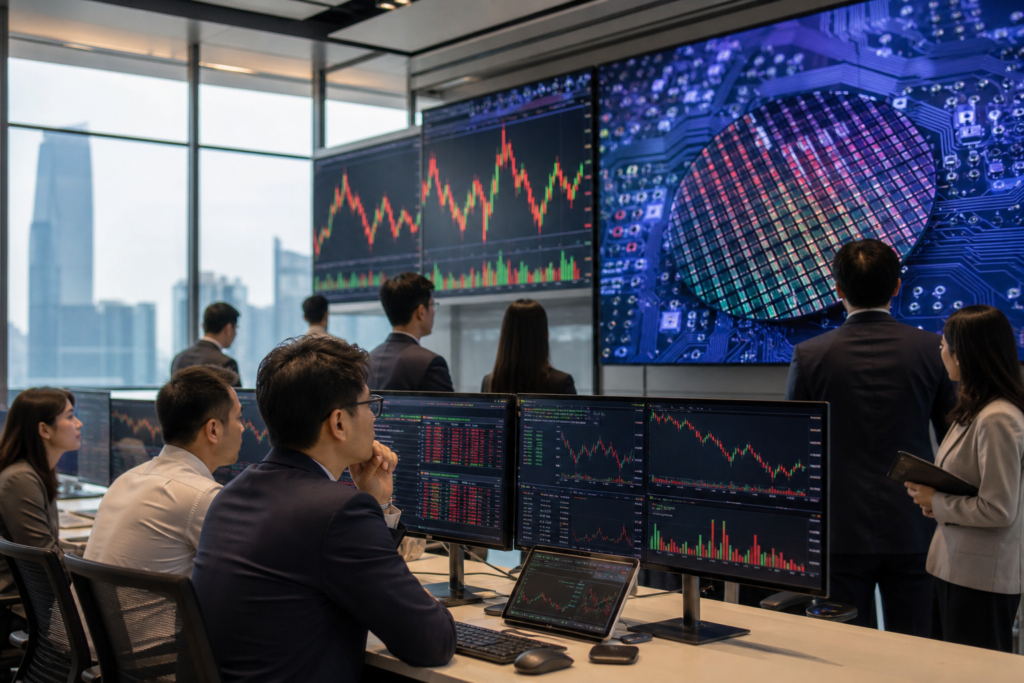
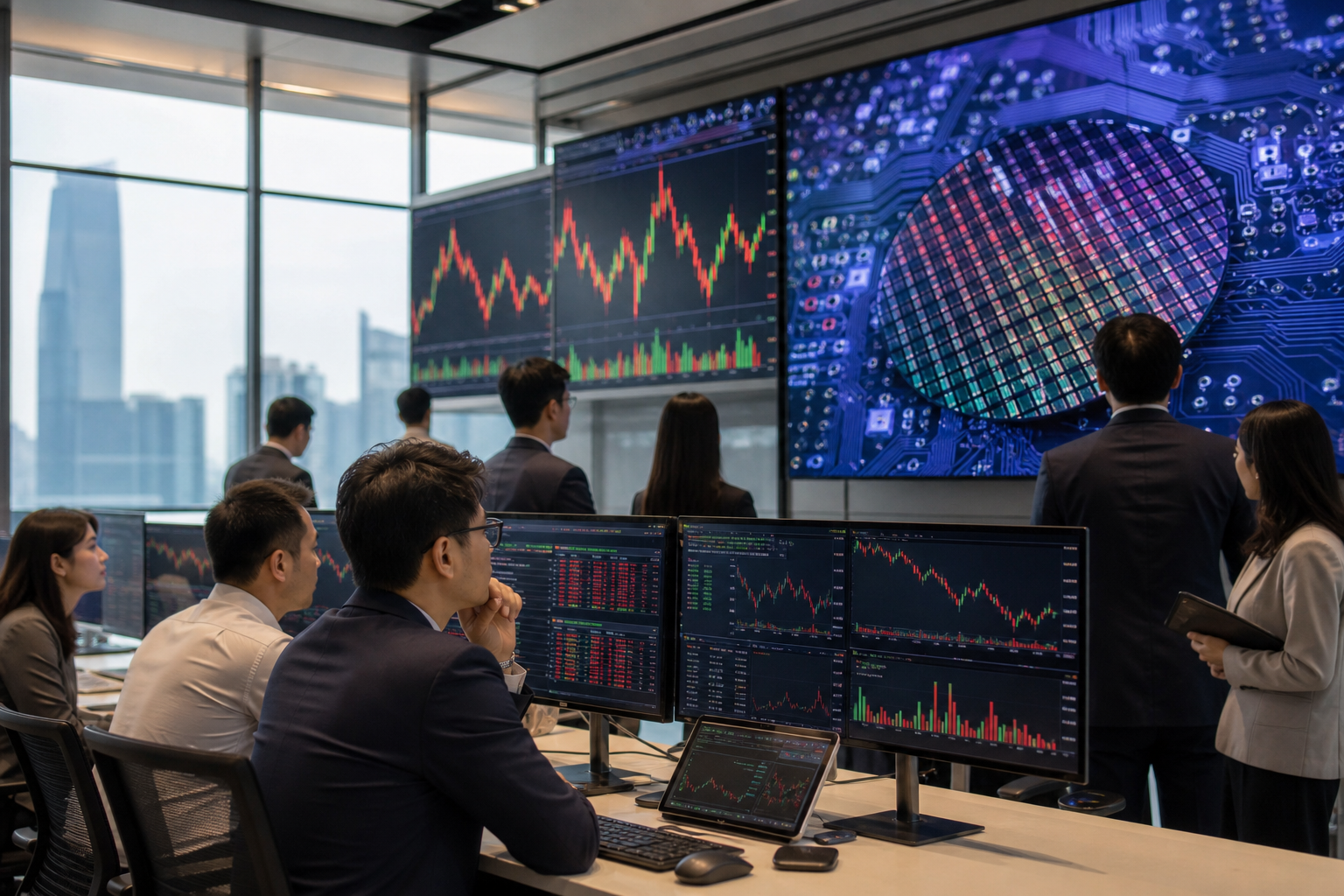
Asian stock markets steadied after a bruising technology-led selloff, but the rebound did not remove the central question hanging over investors: how much future artificial-intelligence growth is already reflected in today’s chip prices?
A Reuters report carried by Business Recorder said the broad MSCI index of Asia-Pacific shares outside Japan rose about 0.8% on Wednesday after losing 3.6% in the previous session. The recovery arrived ahead of major technology earnings and a closely watched US Federal Reserve decision, both capable of reshaping expectations for global borrowing costs and corporate spending.
Why the selloff matters
Semiconductor companies have been among the biggest beneficiaries of enthusiasm surrounding generative AI, data centres and cloud infrastructure. Investors have rewarded firms that design advanced processors, manufacture memory or supply the equipment needed to build increasingly complex chips. That enthusiasm created enormous market value, but it also raised the standard that companies must meet every quarter.
When expectations are modest, solid earnings can lift a share price. When expectations are exceptional, even rapid growth may disappoint if management signals slower orders, higher costs or uncertain demand. That is why current volatility is not necessarily a verdict against AI. It is a debate about timing, price and who will capture the profits from a huge investment cycle.
Competition is another concern. Asian chipmakers sit at the centre of global supply chains, while Chinese manufacturers are investing heavily to reduce dependence on foreign technology. New capacity can expand the market, but it can also pressure pricing and challenge assumptions that today’s leaders will retain the same margins indefinitely.
Interest rates remain part of the story
Technology valuations are particularly sensitive to interest rates because much of their perceived value depends on profits expected years into the future. Higher rates reduce the present value investors assign to those future earnings and make safer assets more competitive. That makes every signal from the Federal Reserve important far beyond Wall Street.
Oil prices and geopolitical risk add another layer. A fresh rise in energy costs can feed inflation, complicate central-bank decisions and squeeze companies and households in fuel-importing economies. Asia includes some of the world’s largest energy importers, so market optimism about technology can quickly collide with anxiety about supply routes and consumer prices.
What investors will watch next
The next set of corporate results should provide more useful evidence than the daily movement of an index. Investors will look for growth in cloud services, orders for AI infrastructure, spending commitments by large technology firms and signs that customers are earning enough from AI products to justify continued expansion.
They will also watch whether the rally broadens. A healthy market does not need every sector to rise together, but a narrow advance dominated by a small group of expensive companies can become fragile. Financials, industrial firms, consumer businesses and smaller technology suppliers may reveal whether economic confidence extends beyond the most fashionable AI names.
For everyday investors, the lesson is less dramatic than the market headlines. A powerful technology can transform industries while shares connected to it still experience deep corrections. Business progress and stock-market performance operate on different clocks. Diversification and attention to valuation remain important even when the long-term story appears convincing.
Wednesday’s rebound therefore looks more like a pause for assessment than a final answer. The AI investment cycle remains powerful, but markets are beginning to demand clearer proof of who pays, who profits and how quickly the returns arrive.