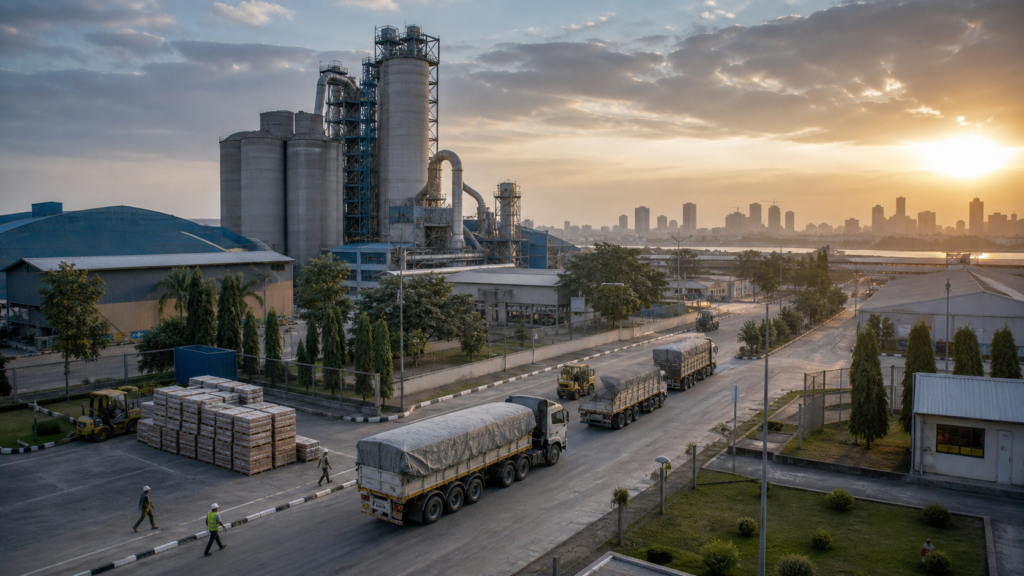
Nigeria’s biggest industrial groups are entering the second half of 2026 with a cautiously optimistic message: the consumer economy may finally be moving out of its most painful adjustment period. That confidence is visible in the expansion plans of BUA Group and its founder, Abdul Samad Rabiu, whose investments across cement, food and infrastructure amount to a long-term bet on domestic demand.
A profile published by Le Monde on August 12 highlighted the scale of Rabiu’s ambitions and the economic backdrop behind them. The important story is larger than one billionaire or one conglomerate. It is about whether Nigeria’s recent currency and inflation improvements can translate into stronger household purchasing power, steadier factory operations and a broader industrial recovery.
A better backdrop, but not an easy one
Nigerian manufacturers have spent several years managing exchange-rate instability, expensive energy, high borrowing costs and consumers whose budgets were squeezed by inflation. Companies that rely on imported machinery or raw materials faced an additional problem: obtaining foreign currency at a predictable rate. Those pressures forced businesses to raise prices, rethink product sizes and delay some investments.
The environment described in the Le Monde report is beginning to look less severe. It notes that the naira has appreciated, access to foreign currency has improved and inflation has fallen from its earlier peak. For makers of cement, flour, sugar and other everyday goods, that combination matters. More stable input costs make production planning easier, while slower price growth can gradually restore demand.
That does not mean the hardship is over. Even when headline inflation falls, prices rarely return to their old levels. Families still have to rebuild real income after a prolonged cost-of-living shock. Interest rates and infrastructure costs can also keep pressure on businesses long after currency markets settle down.
Why consumer recovery matters to industry
BUA’s portfolio gives it exposure to two different sides of a recovery. Cement demand reflects construction, housing and public infrastructure, while food products are tied more directly to daily household spending. If incomes stabilize and government projects continue, both sides can improve together.
This is why large industrial investments are closely watched beyond the stock market. A new plant or expanded production line can support jobs, contractors, transport companies and local suppliers. Greater domestic output may also reduce the country’s need for some imports, easing pressure on foreign exchange. The benefits are not automatic, however. They depend on reliable operations, competitive pricing and distribution that reaches consumers outside the largest cities.
For investors, the attraction of an integrated industrial group is its ability to manage parts of its own supply chain and spread risk across products. The danger is that large capital projects require heavy spending before they generate returns. If economic growth disappoints or borrowing costs stay high, expansion can strain even a strong balance sheet.
The risks have not disappeared
Security remains one of the biggest constraints on Nigeria’s economic potential. The Le Monde report points to worsening insecurity in the north, where violence can prevent farmers from cultivating land. That has consequences throughout the economy: lower agricultural output can lift food prices, disrupt processing businesses and weaken rural incomes.
Power and logistics are another persistent challenge. Manufacturers often have to provide their own electricity or absorb the cost of unreliable supply. Moving goods across a large country can be slow and expensive. These structural problems limit how quickly improvements in inflation or the exchange rate show up in company results.
Policy consistency will be equally important. Businesses can adapt to difficult rules when those rules are predictable; sudden changes are harder to manage. Investors will look for evidence that currency reforms, tax policy and industrial incentives remain coherent enough to support multi-year projects.
A signal about Nigeria’s next phase
Rabiu’s decision to keep making large domestic investments is a vote of confidence, but it should not be mistaken for proof that a full recovery has arrived. The more useful interpretation is that major operators see enough improvement to plan beyond crisis management. That is a meaningful shift after years in which survival and cost control dominated corporate decisions.
The next test will be whether stronger macroeconomic indicators reach ordinary Nigerians. A recovery that exists only in currency charts will not sustain demand for food, housing materials or consumer services. Real wages, employment and access to affordable credit will determine whether industrial optimism becomes broad-based growth.
For now, Nigeria’s industrial expansion story sits between resilience and possibility. Large companies have endured a punishing adjustment, and some are preparing to accelerate again. If inflation continues to ease, foreign exchange remains available and security improves, their investments could help turn stabilization into production. If those gains stall, the same projects will reveal how much work remains.