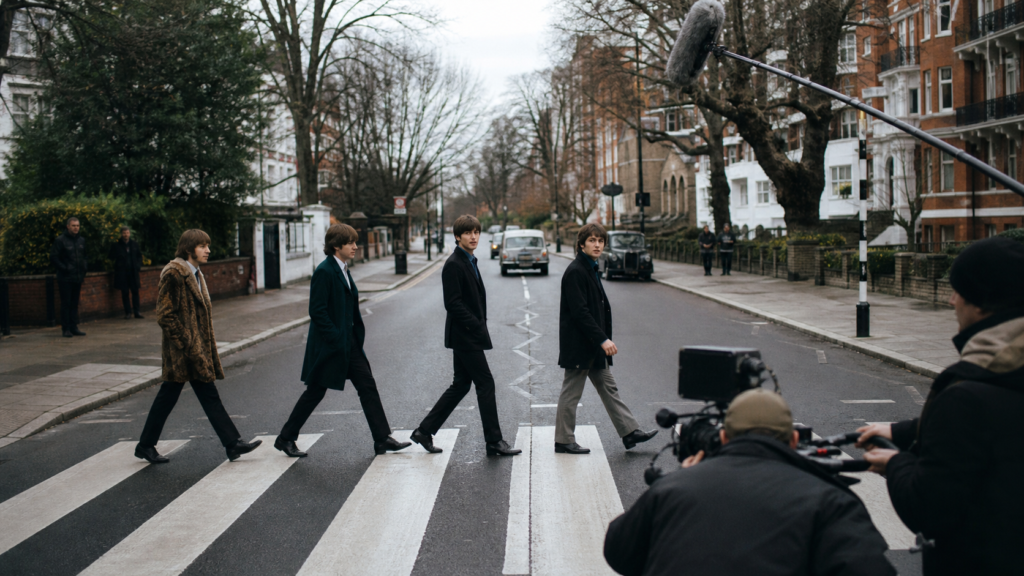
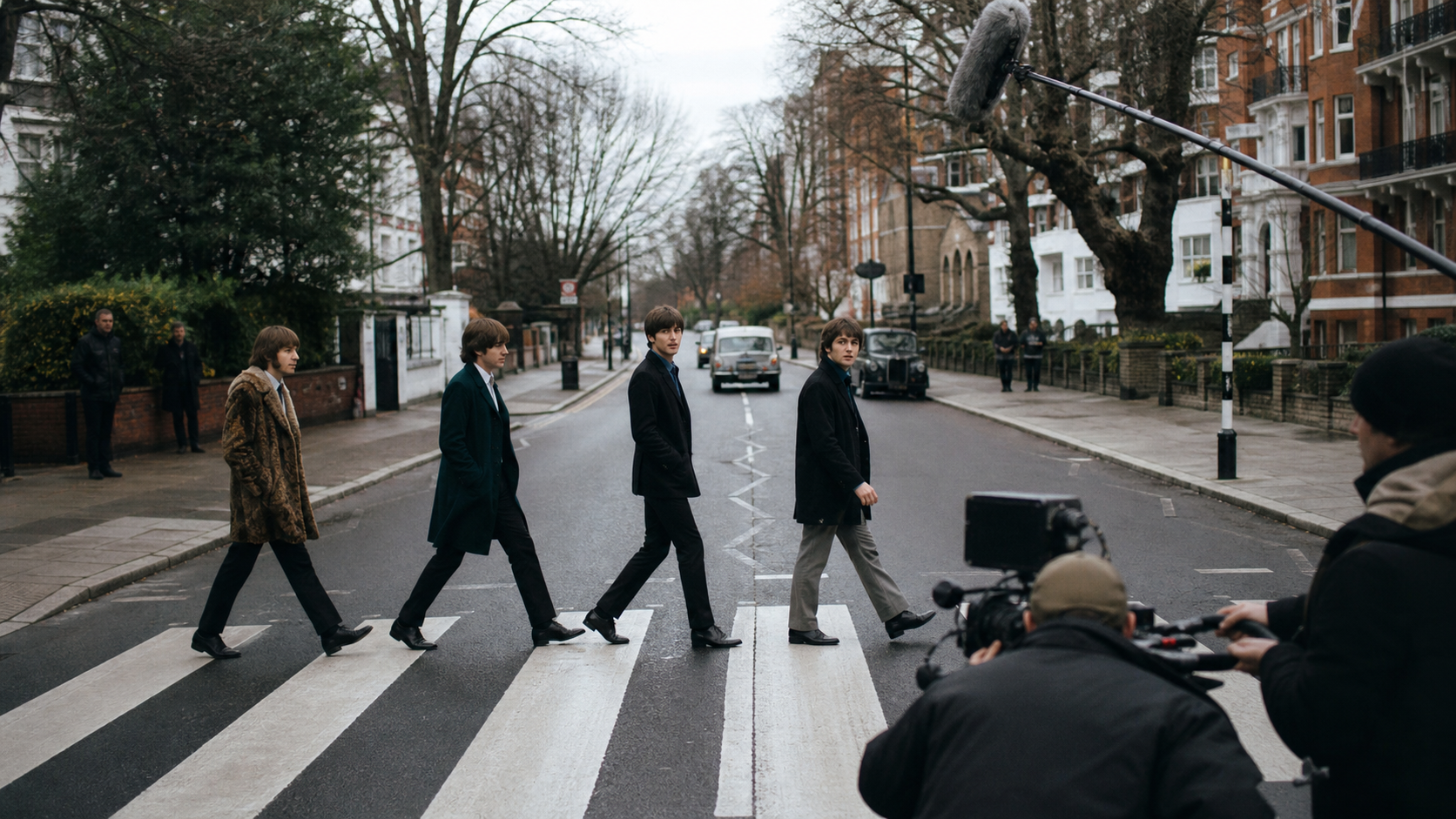
A group of actors connected with the forthcoming Beatles screen project has been spotted filming at the Abbey Road crossing in London, Variety Australia reports. Paul Mescal, Joseph Quinn, Barry Keoghan and Harris Dickinson were seen at the location, instantly linking the production to one of popular music’s most recognizable images. The choice is obvious, but it is not trivial: filming there turns a familiar photograph into a living part of the story.
Abbey Road is both an ordinary street and a global landmark. The 1969 album cover transformed a pedestrian crossing outside the recording studios into a destination visited by fans from around the world. Recreating that moment at the real location gives the filmmakers physical authenticity that a soundstage would struggle to reproduce. It also guarantees intense scrutiny, because viewers know the posture, spacing and visual rhythm of the original image almost by memory.
The challenge of a very familiar story
A Beatles drama faces a difficult creative problem. The broad outline of the band’s rise, internal tensions and breakup has been told in books, documentaries, interviews and archival releases. Many viewers will arrive with strong opinions about the personalities involved. A successful film cannot rely only on imitation or nostalgia; it must find a human perspective that makes well-known events feel immediate again.
Real locations can help. Studios, streets and performance spaces provide texture that costume and dialogue alone cannot supply. They remind audiences that the Beatles phenomenon unfolded in specific rooms and neighborhoods before it became mythology. Abbey Road in particular represents the intersection of craft and fame: a working studio where experiments were made, and a public crossing that became a symbol recognized almost everywhere.
Performance under pressure
The actors will be judged on more than physical resemblance. Fans will listen for speech patterns, humor, musical confidence and the complicated chemistry of four people whose identities became inseparable in public. The strongest music biopics avoid reducing artists to a sequence of wigs, hit songs and famous arguments. They use performance to show how collaboration works and why it eventually becomes difficult.
That task is harder when every central character is already an icon. Too much reverence can flatten the drama, while forced controversy can feel exploitative. The production must make space for ambition, friendship, competition and exhaustion without pretending that a film can deliver a final verdict on decades of competing memories.
Why the location matters to London
Filming at Abbey Road also highlights the continuing economic life of music heritage. Fans support local shops, tours and cultural attractions, while screen productions bring crews and spending into the city. A major project can renew interest in the catalog and introduce younger audiences to the history behind a visual reference they may have encountered online without context.
There is, however, a difference between using heritage and being trapped by it. The crossing will create striking promotional material, but the film’s value will depend on what happens after the recreation. Audiences need interior lives, dramatic choices and a sense of discovery. The famous image should be a doorway into the story rather than its destination.
A test of perspective
The renewed attention around Abbey Road shows why the Beatles remain unusually powerful subjects. A few photographs from a shoot can generate worldwide discussion before a finished scene exists. That level of recognition is a marketing advantage, yet it raises expectations for accuracy and emotional depth.
Returning to the real crossing is a promising statement of intent. It suggests that place will matter, and that the production understands the visual language fans bring with them. The greater challenge is to move beyond reenactment and show four young musicians building something none of them could completely control. If the film can do that, Abbey Road will feel less like a checklist moment and more like the point where history, memory and cinema briefly occupy the same street.
Music will be another decisive test. The Beatles’ recordings are not background decoration; they carry narrative expectations of their own. How songs are placed, performed and allowed to breathe can reveal whether the project understands the evolution of the group. The filmmakers must balance the pleasure of recognition with dramatic restraint, using familiar material to deepen character rather than simply cue applause.